







How AI Is Quietly Reshaping Go-to-Market Strategy
A reflection from recent conversations in the tech community
Over the past few weeks, nearly every industry event I’ve attended has had one consistent theme: AI.
From panel discussions to hallway conversations, the topic keeps surfacing not just as a technology trend but as something already reshaping how organizations think about growth.
What struck me most is how quickly the conversation moves beyond the technology itself. The real shift seems to be happening in how companies approach go-to-market strategy.
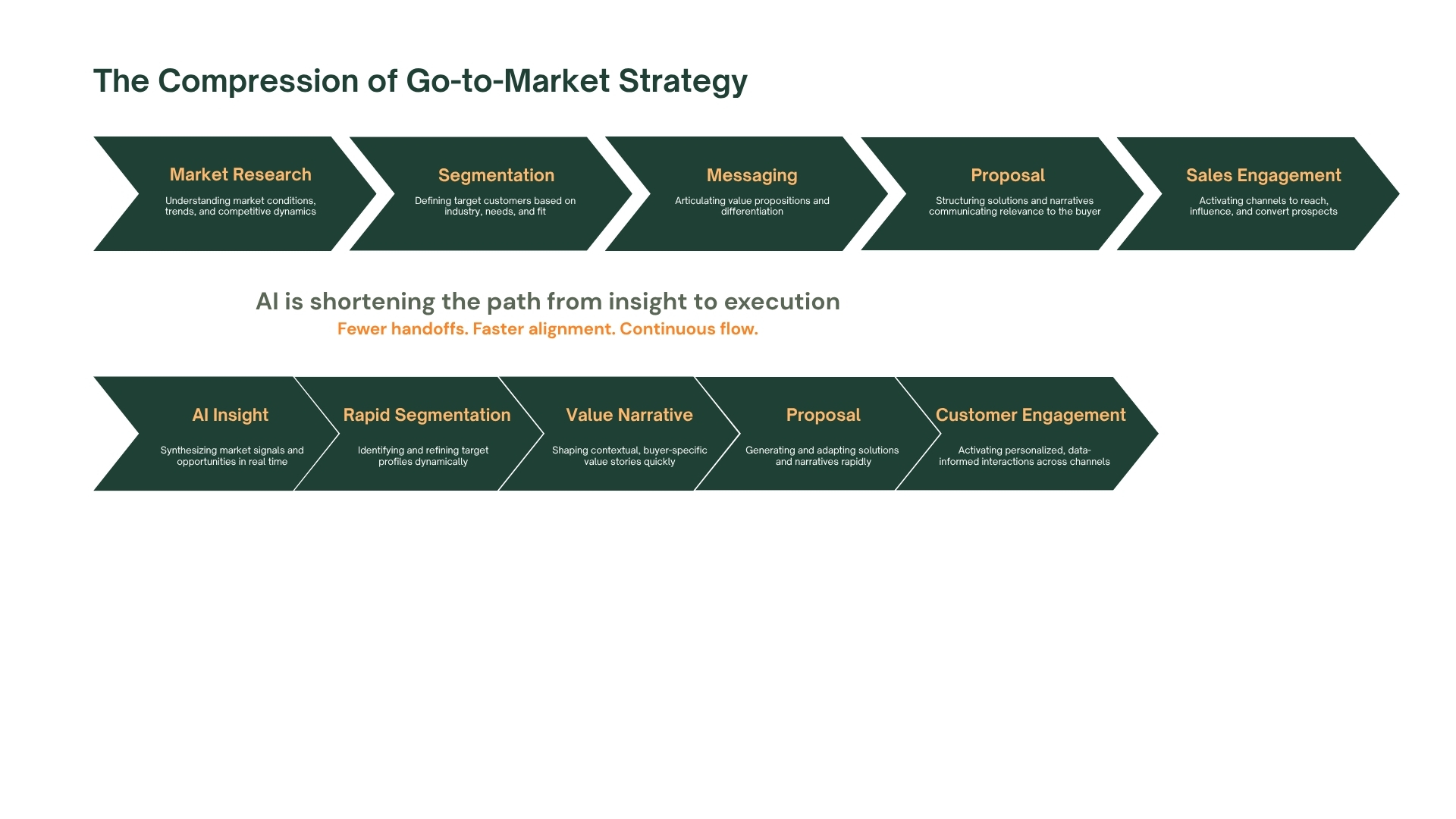
For years, the go-to-market strategy has relied on experience, research cycles and structured planning. Those fundamentals still matter. What is changing is the speed at which teams can move through them. AI is accelerating steps that once took weeks or months. This is what I think of as go-to-market compression. The steps are not disappearing; they are being condensed.
That speed is changing how organizations identify opportunities, build narratives and bring capabilities to market.
AI is accelerating insight, not replacing strategy
There is still a lot of noise in the market around AI replacing jobs or automating decision-making. In reality, the most practical use cases emerging today are much simpler. AI is accelerating the path from insight to action from insight to action.
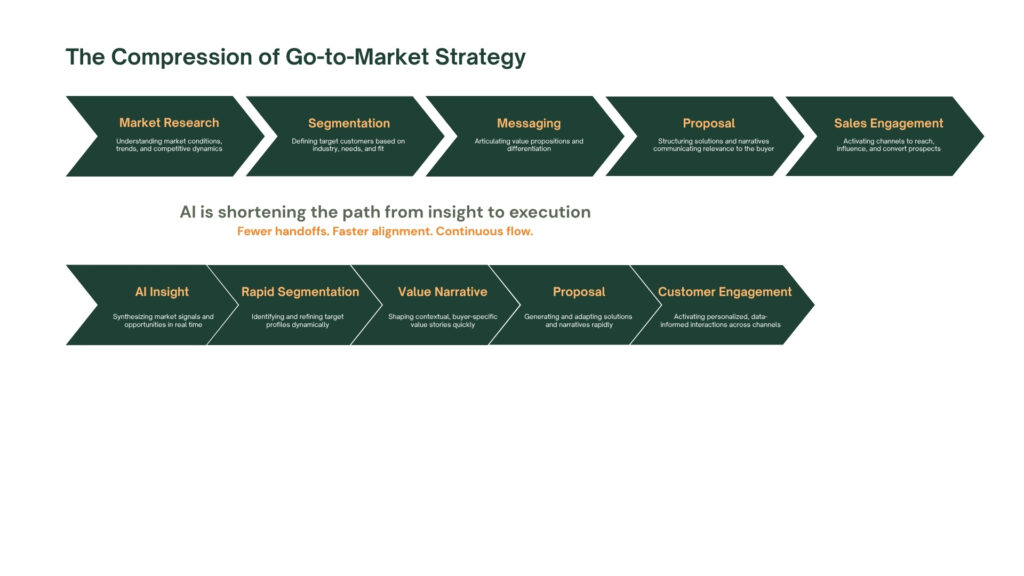
AI is not removing steps in go-to-market. It is compressing them.
In many organizations, go-to-market teams spend significant time gathering information before they can even begin shaping a strategy. Understanding market trends, identifying potential customer segments, analyzing competitors and synthesizing insights into a commercial narrative can take weeks.
AI tools are now compressing that timeline dramatically.
Market research that once required extensive manual analysis can now be synthesized quickly. Competitive landscapes can be mapped faster. Early messaging drafts can be created and refined much more quickly. The strategic thinking still belongs to people. But the process that supports it is becoming far more efficient.
The shift is not just about speed. It is about expectation.
When insight can be generated quickly, the value of go-to-market leadership moves upstream. The differentiator is no longer access to information. It is the ability to interpret, prioritize, and act on it.
In practical terms, this means:
- less time spent gathering inputs
- more time spent making decisions
- and a higher expectation for clarity in direction
Organizations that continue to operate with extended research cycles may find themselves outpaced not because they lack capability, but because they are slower to act on it.
Where AI is already influencing GTM execution
In conversations with leaders across technology, consulting and fintech organizations, several practical applications keep emerging.
Market intelligence is becoming more dynamic. AI tools can help organizations quickly synthesize industry signals, competitor movements, and emerging opportunities.
Customer segmentation is becoming more precise. Instead of relying only on static personas, companies can analyze patterns across industries, firmographics and behavioural signals to identify ideal customer profiles.
Sales enablement is accelerating. Proposal development, solution narratives and pursuit preparation are becoming faster and more tailored to specific client needs.
Account prioritization is improving. AI tools can help identify which companies are most likely to be entering transformation cycles, allowing sales teams to focus their efforts more strategically. None of these applications replaces human expertise. What they do is reduce the friction between insight and execution.
In one recent conversation, a team described reducing proposal development time from several weeks to a matter of days by using AI to structure initial drafts and tailor messaging to specific industries.
What did not change was the need for a clear value narrative. The teams that saw the most benefit were those that already understood their positioning. AI simply allowed them to move faster.
The opportunity for organizations with complex capabilities
This shift is particularly relevant for organizations operating in complex technology environments.
Many companies have strong technical expertise and valuable capabilities, but translating that capability into clear market narratives often takes time. Identifying the right vertical opportunities, articulating differentiated value, and aligning sales and marketing around those opportunities can be difficult.
AI is starting to make parts of that process more fluid.
The ability to analyze markets quickly, refine positioning faster, and support proposal development in real time means organizations can move from capability to commercial opportunity more efficiently.
In practical terms, it means the gap between technical innovation and revenue growth can begin to shrink.
Where this can go wrong
The risk is not that organizations will ignore AI. It is that they will apply it without changing how decisions are made.
Faster insight does not automatically lead to better outcomes.
In some cases, it can create more noise:
- more data, but less alignment
- more outputs, but less clarity
- faster proposals, but weaker positioning
Without a clear strategic lens, AI can accelerate activity without improving effectiveness.
The organizations that benefit most will be those that pair speed with discipline.
One pattern that is beginning to emerge is an increase in output without a corresponding improvement in outcomes. Teams can produce more content, more proposals and more analysis in less time. But without clear measurement frameworks, it can be difficult to determine whether that activity is actually driving better results.
In some cases, AI is accelerating volume rather than impact.
This is where discipline becomes critical. Organizations need to define what success looks like and ensure that AI-enabled workflows are tied to meaningful indicators, such as conversion rates, deal velocity and win quality, rather than simply production speed.
The real challenge ahead
Go-to-market strategy has always been about connecting capability to opportunity.
What is changing is the pace at which that connection can be made.
As the path from insight to execution shortens, the advantage will shift to organizations that can think clearly, decide quickly, and align their teams around a focused narrative.
AI is not redefining strategy.
It is compressing the space in which the strategy operates.